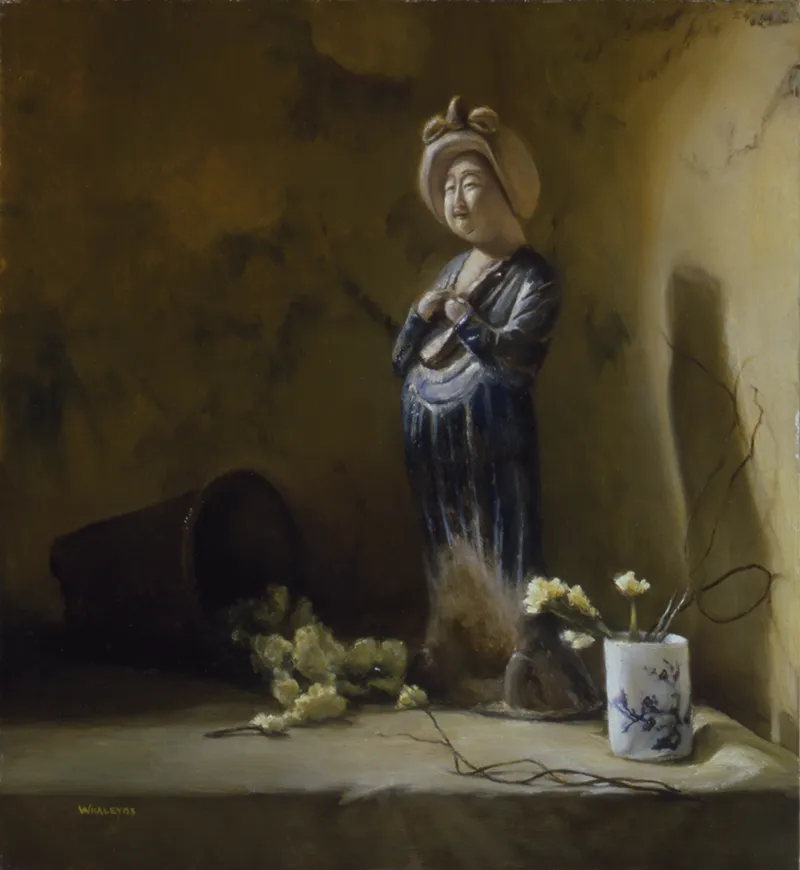
On attention, structure, and the slow process of building a painting strong enough to hold what first arrived quietly.
Dear Friend,
I’ve been thinking lately about the hidden life a still life leads— not just on the canvas, but in the long arc from its first appearance to the moment it leaves my studio.
The painting Porcelain with Teacup began when something caught my attention and refused to let go — a quiet conversation between shapes, color, and the meaning objects carry. I became fascinated by how light traveled across the surface, how it blended, how it paused, and how it finally met the shadow that held it.
The early stages of a painting feel like discovering something rather than building it. I move slowly, listening more than deciding. I follow small visual and emotional clues — how forms lean toward each other, how shadows soften or deepen, how color begins to create a mood I can’t yet name.
And then, gradually, another part of the process arrives. The painting begins to require structure. Discipline. Craft. Decisions about composition, edges, relationships, and balance. I often think of this phase as building something sturdy enough to hold whatever quietly arrived during those early searching moments.
At some point — and it is never predictable — the painting changes its posture. It begins to hold its own presence in the room. It no longer feels like something I am pushing forward. Instead, it feels as though it has stepped forward on its own.
That moment still surprises me every time.
It arrives quietly. I’ll walk into the studio and notice that the painting feels different. It has a gravity to it. It feels settled. That is usually when I begin to feel a growing respect for the work — and, unexpectedly, tenderness.
Paintings require time, patience, and attention, but they also ask for a kind of trust. There is a moment when I realize the work no longer belongs entirely to me. It has become something that can exist in the world without explanation.
Completion, for me, is not dramatic. It feels more like resolution. A deep exhale. A quiet recognition that the conversation between myself and the painting has reached its natural close.
And then comes the part many people assume must be difficult — letting the painting leave the studio.
Surprisingly, that moment usually brings two emotions at once. Relief. And gratitude.
Relief, because space opens again — physically, creatively, emotionally. Every painting occupies more than wall space. It occupies attention, memory, and creative energy. When it leaves, something within me opens toward the next unknown work.
And gratitude, because paintings are meant to live beyond the studio. My responsibility ends with making the work as honestly and carefully as I can and trusting that it will find its own place in the world.
In a time when so much around us feels unstable, distracted, or uncertain, I am increasingly aware of how essential art, family, and the passions that anchor us truly are. They return me to looking carefully — to honoring what is real, present, and quietly enduring. I believe this kind of attention — in art and in life — is one small but necessary way we remain awake to the world we are responsible for shaping.
That commitment to attention is what ultimately guides how I work in the studio as well.
For me, the studio is where paintings begin their life. The world is where they learn to stand on their own.
At the edge of light,
~ Melanie